On January 30th, Bucknell’s Director of Campus Sustainability Victor Udo sat down with the students of ENLS 103 to discuss the university’s ongoing environmental efforts. With a long history of environmental education— including a PhD from the University of Delaware in Urban Affairs and Public Policy and an MSc. in Energy Management and Environmental Policy from the University of Pennsylvania— Udo is leading the path to a brighter future for the University and its inhabitants.
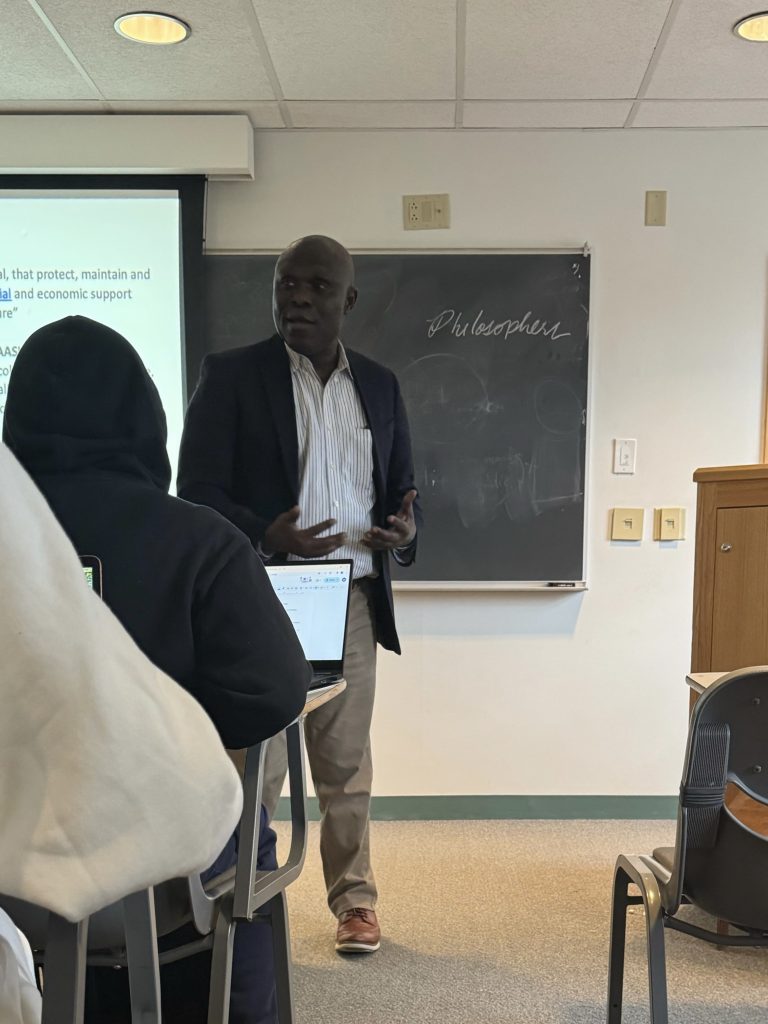
When first hired in 2019, Udo was tasked to put together a ten-year sustainability plan; one that he has spent the years since bringing to fruition. “The process of creating a plan like this is a shared vision”, he stated. “What do people want in their community?” The proposal focuses on three ultimate goals: the elimination of waste, ecological conservation and restoration, and carbon neutrality by 2030. All three are outlined in the ongoing objectives for the Association for the Advancement of Sustainability in Higher Education (AASHE), an organization dedicated to goals of environmentalism in postsecondary education.
Udo’s job also requires him to act as an ongoing member of the President’s Sustainability Council, an initiative headed by President Bravman and consisting of a number of Bucknell officials from many different offices, departments, and organizations on campus. In addition to the ten year plan, each semester the team creates a shorter-term list of resolutions that focuses on the coming months at hand. This guarantees that meaningful tasks are created each step of the way to ensure that longer term goals will be met by 2030.
One of the ways Bucknell has implemented this plan so far has been the greenway, “a four mile loop around campus so that people can connect with the environment”, Udo explained. This project is the perfect conglomerate of not only Bucknell’s sustainability goals, but of recent efforts to bring local history into the conversation as well. The walkway features many different areas of reflection: everything from butterfly gardens to consider nature’s beauty to Civil War monuments to pay credence to our collective past. It is Udo’s hope that projects such as these will “increase the long-term viability and resilience of our environmental, social, and economic support systems, so that we can create a more just, equitable, and abundant future”.
However, Udo emphasizes that institutional action is not enough when it comes to making meaningful change to our environmental facilities. If true progress is expected to be made, individual efforts make an impact as well. Seemingly menial tasks such as recycling or composting, conserving energy use by turning off lights, and using energy efficient devices and vehicles are some of the smaller ways to start. Furthermore, he insists that conversations around these matters are not merely important, but essential. “If the journalists do not tell the story about the activists, no one knows about it,” claims Udo. Throughout the course of his presentation, Udo continually drove home the fact that open conversation and transparent communication will be the only true path to progress. We must not only connect with nature and ourselves but with each other to preserve what is most important— the protection and conservation of our world as we know it.
Leave a Reply